The Monkey Who Broke the Internet’s Heart: A Diagnosis
How a viral story from a Japanese zoo became a radical manifesto for empathy in an age of digital alienation
 Jan Novak
  23/02/2026
  292 views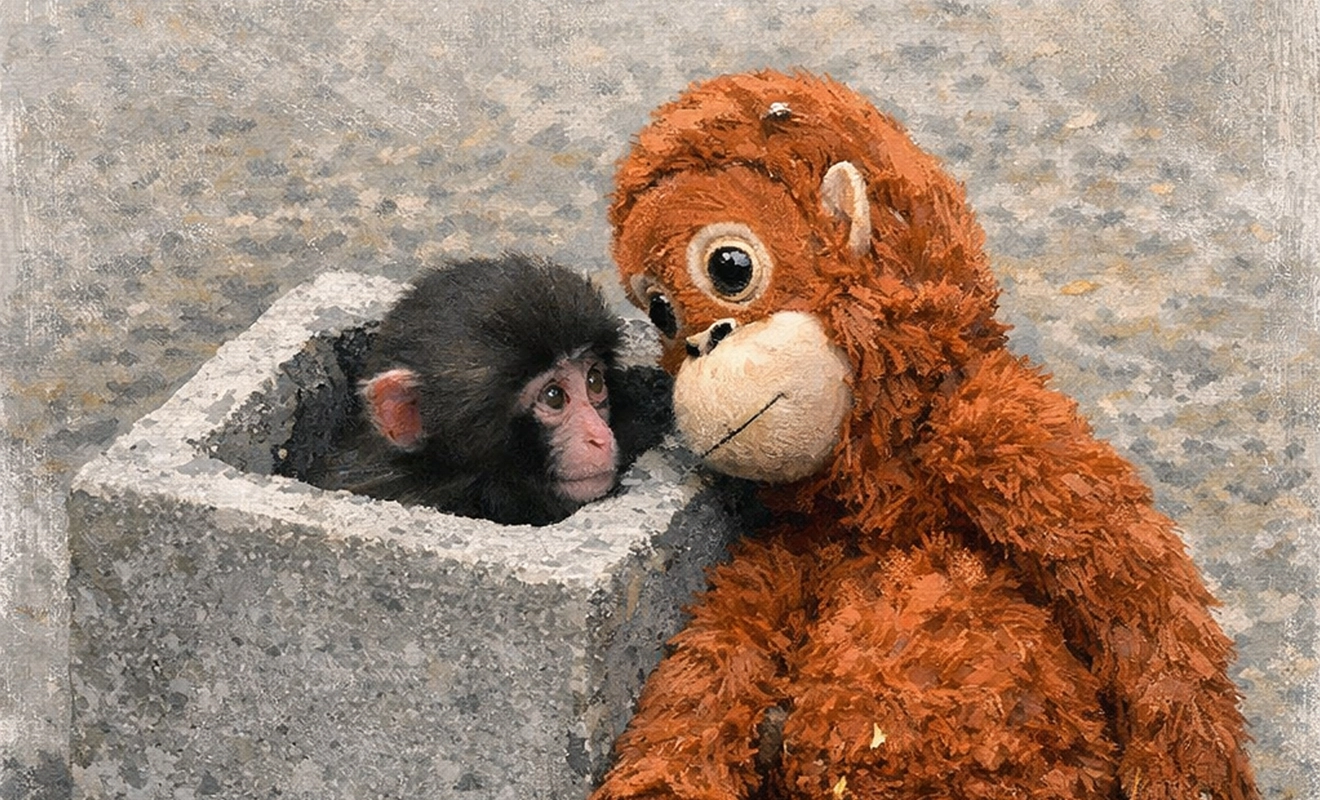
Navigating the endless scroll lately feels like scavenging through a digital landfill for a scrap of actual life. Between the aggressive crypto-shilling no one quite follows and the frantic, high-octane reports designed to keep us perpetually wired, the algorithm occasionally serves us up a treat. Or, in this case, a monkey.
Punch is a baby Japanese macaque, born last July at Ichikawa City Zoo. And with him comes a narrative there’s no escaping. Not because of the ‘beauty of nature’ — there’s precious little natural about a macaque clinging to a plush IKEA orangutan in a concrete enclosure — but because of the sheer absurdity of it all. It’s not that he’s ‘adorable’. The internet is littered with ‘cute’. It’s that these images hold something that refuses to be filed away as mere entertainment.
Zoos are, at their core, PR-driven relics, desperate to convince us that life behind bars is actually a ‘living classroom’. And as if these institutions weren’t sombre enough, Punch was forced to face the cruelty of his own kind before he’d even found his feet. His mother — her instincts surely frazzled by the confinement and the constant rotation of paying spectators — simply opted out. As for the others, they wasted no time in baring their teeth. Punch faces a barrage of shoving, bullying, and a clinical kind of shunning. What follows is a scene that, if it weren’t documented, would feel too surreal even for an early Werner Herzog film: the keepers hand him a Djungelskog — that viral IKEA plush orangutan. It is the only thing currently standing in for an entire troop. Fans of the little guy have already dubbed it ‘Oranmama’.
This is the image that sticks. A bright orange plush toy — worlds away from the factory line that churns out thousands exactly like it — becomes the sole anchor for a being whose ancestors evolved over millennia to crave the warmth of living flesh and the coarse texture of real fur. It’s easy to sneer at consumerism, but in Punch’s world, this twenty-quid surrogate is the only thing that hasn’t turned its back on him. He carries it everywhere, nuzzles it, and falls asleep clutching it to his chest, retreating behind its orange fluff when the world gets too loud.
Watching these clips, we feel something far deeper than mere concern — it’s that primal, protective instinct that kicks in when you witness a being left entirely to its own devices. This isn’t the cheap sentimentality we waste on films with happy endings. Thousands of miles away, we’ve become a sort of digital vigil, united in the hope that this tiny creature just makes it through the day. Zoos are bleak enough as it is, but Punch’s story has injected a fresh hit of bile into an already sour atmosphere.
To Oranmama and the keepers: thank you for trying to patch the hole in a broken heart, even if it’s only with a scrap of polyester.
A Crowd of One
There is something deeply unsettling about the sight of a Japanese macaque troop ignoring its own blood. On ‘Monkey Mountain’ — a place that, by every law of biology, should be a stronghold of togetherness — Punch is a pariah. He moves through the troop, but he is ignored. In the rigid hierarchy of the enclosure, he is simply in the way. That image — a newborn standing utterly alone in a crowd of his own kind — cuts straight to the core of our collective anxiety. It taps into that primal, existential dread: the fear that you can be surrounded by thousands of your own likeness and still have no one.
The reason this story has gripped millions is simple: we are witnessing our empathy outgrowing our definitions. This is no longer the quiet, niche sorrow of animal rights activists; it’s a groundswell that has swept up even those who usually wouldn’t blink at such stories. This response shows that our concern is no longer limited by biology. We have reached a point where we simply refuse to accept his isolation.
For a long time, we believed the moral community was an exclusive club, reserved for those who shared our surnames, our languages, or the colour of our skin. Over time, we expanded that circle, yet we always jealously guarded its perimeter at the edge of ‘humanity’. Punch forces us to tear down that fence.
When we feel that visceral urge to protect him, it isn’t a lapse into sentimentality; it’s an act of evolutionary justice. We are finally admitting that suffering carries no passport, and that loneliness requires no intellectual validation to be real.
It was the keepers — supported, one would hope, by the zoo’s management — who were the first to refuse to look away, keeping him alive by ensuring he had someone by his side. They chose to do something that, on a balance sheet, makes no sense at all. Yet, that commitment sparked a chain reaction no one saw coming: IKEA Japan heard the cry and donated an entire ‘plush troop’. It stands as proof that when human care and corporate awareness align, a ‘useless’ individual is given a fighting chance to survive in a world that had, at first, written him off.
Punch’s struggle teaches us that ethics is not a list of rules inscribed in books, but the ability to recognise the face of the ‘other’ — even when that face has fur and wide, terrified eyes. Our concern for him is proof that, despite the digital barricades we’ve built, we remain capable of radical tenderness. It is an expansion of the moral circle to the point where who you are no longer matters; all that matters is the capacity for suffering, and our willingness to acknowledge that suffering as legitimate.
Recognising the ‘Other’
Critics will always reach for the same word: anthropomorphism. They will claim we are casting Punch in a human drama, lending him our own vocabulary of grief, and that in his small, simian brain, he feels no ‘existential pain’, only ‘biological discomfort’. But that is the most arrogant lie humanity ever devised just to sleep more soundly. The truth is actually the reverse: we don’t see a human in Punch; rather, we recognise the Good in ourselves.
Our sorrow over his fate is not an ‘update’ to our morality, but a recollection. It is that suppressed, primal part of our consciousness that knows the need for closeness existed millions of years before we ever learned to write poetry about solitude.
Punch doesn’t cling to a plush orangutan because he recognises the meaning we’ve projected onto it; he clings to it because it is a neurochemical imperative. Without that touch, the primate brain shuts down, the heart slows, and the will to live simply evaporates. This is not a human trait; it is a law of life.
This recognition reshapes our understanding of society itself. If caring for a being of another species can move us this profoundly, it means our circle of responsibility is organic, not contractual. We don’t care for Punch because we’ve ‘decided’ to; we care because we are incapable of doing otherwise. That internal pressure to aid a suffering being — regardless of chromosome count, skin texture, or the wilderness they hail from — is perhaps one of the few remaining hopes for our society. It is proof that empathy is not a finite resource to be depleted, but a muscle that grows stronger the more we use it.
The Post-Human Compass
The latest footage from Ichikawa shows Punch attempting what zoologists call socialisation, though in practice, it looks more like a precarious walk through thorns. He is slowly returning to his own kind, each side approaching with a tense caution, as he tries to decipher the rules of a world that offered him so little room. This is the bridge that must be crossed. And this is why care must function as a form of civilisational defiance — the conscious decision to stand with the weakest in a world that fetishises strength and dominance.
What I am speaking of is the expansion of the moral community to its outermost limits. If we are willing and able to adopt an abandoned infant from the other side of the planet into our circle of responsibility, then our ethics are no longer a matter of law, but a matter of nature. Caring for Punch is an act that negates the zoo as an institution of alienation and exploitation; it transforms it — if only for a fleeting moment — into a space of redemption.
If this story leaves anything behind, let it be more than just another surge of fleeting compassion. Let it remain a truth that every pain is our own, for the boundary between ‘them’ and ‘us’ only exists until we choose to cross it. It is up to us to reckon with the fact that the limit of our species is not the limit of our care — and for IKEA to face the truth that their product now serves a purpose no designer could have ever envisioned.
- Share
-

-

-

-

-

-

 441
441
 430
430
 372
372