What Happens When Emina Goes Big
A close look at the creative, production and authorship choices behind Emina Jahović’s Belgrade Arena leap
 Jan Novak
  19/01/2026
  95 views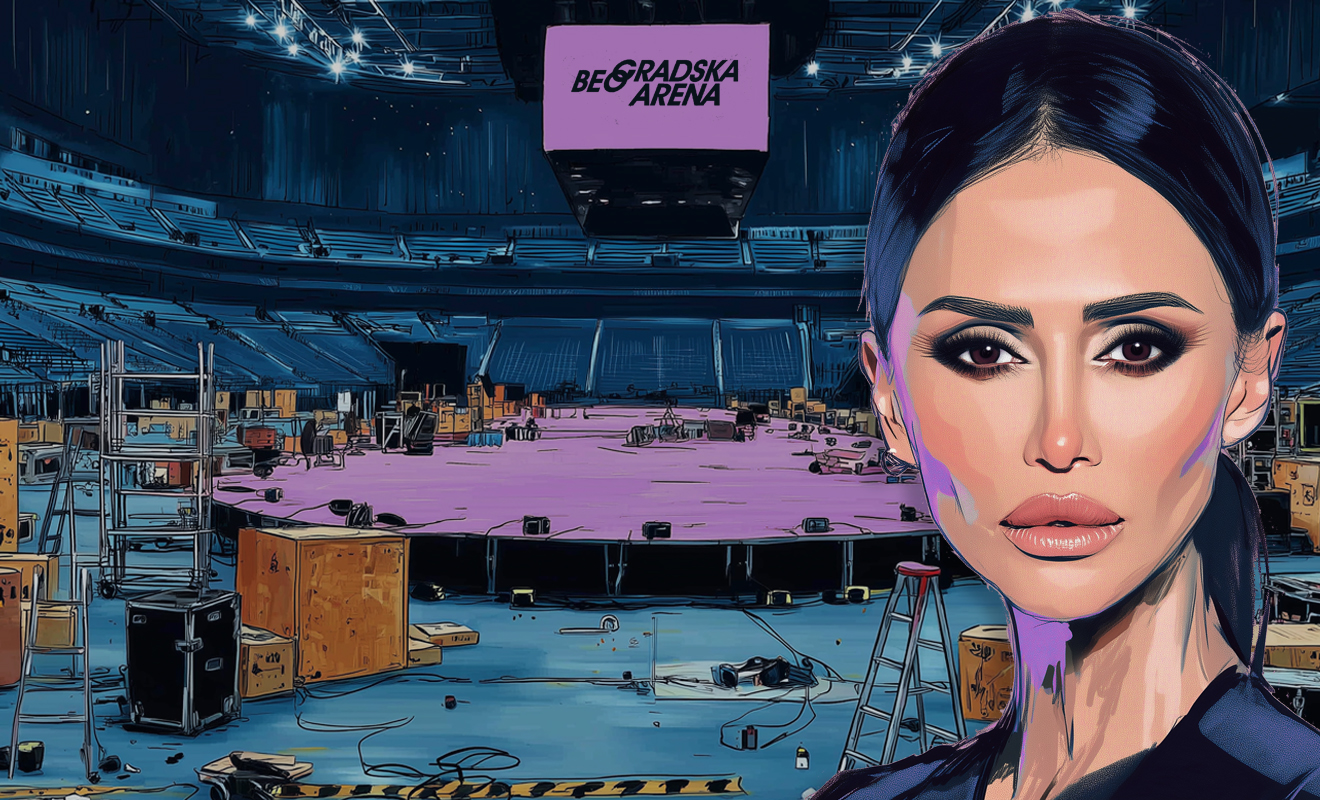
Calling her a comeback act would be misleading. Emina Jahović never disappeared — what shifted was the size of the room. Only once her music moved into large halls did it become clear that the conversation around her is one of scale, not relevance. Svitanje, her sixth studio album, released seven years after Dalje, was not made to fill a gap in her discography. It was made to justify it. With Svitanje, Emina is not trying to sound contemporary, but distinctive — something that, in her case, has always meant the same thing. Writing and producing the record herself, in collaboration with Turkish musicians, Emina has crafted an album that resists excess: emotion without melodrama, introspection without indulgence, love without spectacle. It speaks to faith, to womanhood, and to the self — a strength that becomes more complex when translated into venues that require a different register.
Three nights at Sava Centar, accompanied by a symphonic orchestra, seemed like the logical next step. The concerts were restrained, elegant, almost ceremonial, and initially planned as a one-off, until the response from the audience caught even Emina off guard. What followed was momentum: more dates, new cities — Sarajevo, Budva, Jahorina, Podgorica — then returns, a shift in format, and ultimately the big announcement. Belgrade Arena, 3 October 2026, with Sarajevo’s Skenderija to follow later that month. At that point, the question was no longer whether Emina had an audience, but whether that audience was ready for what came next.
Arena Anxiety
The challenge lies in the fact that, by local standards, Emina has never been perceived as a big star. There is no uninterrupted chain of megahits, no stadium mythology, no carefully cultivated spectacle. Her career is made up of precise, lasting moments, always separated by time — and between her songs, there has always been room for life to happen. While mainstream memory tends to reduce her to one evergreen, Vukovi, and a handful of notable duets — with Milica Todorović, Željko Joksimović and Amel Ćurić — every phase of Emina’s career has left a trace. Her audience has remained remarkably intact. Which is precisely why the Arena demands clarity of intention before scale: meaning has to come first, long before production steps in to translate it. The Belgrade Arena has a way of rejecting half-formed ideas. It recognises conceptual weakness faster than spectacle can camouflage it. Without clear creative direction, it becomes nothing more than scale without meaning.
The regional backdrop adds another layer of complexity. Arena shows have become routine — booked, sold out, repeated — less cultural moments than social imperatives. This logic can generate numbers, but it cannot replace a strategy. Having never subscribed to aggressive commercial tactics, Emina cannot depend on passive audience loyalty. Her currency lies in intention, not simulation.
Presence Over Performance
Large venues inevitably pose uncomfortable questions. What must Emina’s Arena show be to truly justify itself? Does the Belgrade Arena require Emina as she is, or a version of her shaped by its scale? Simply upsizing Sava Centre would be a fundamental error. That chapter is closed. The Belgrade Arena has to begin something else entirely. Choosing a 360-degree stage signals confidence rather than camouflage. It’s a smart but demanding choice, one that requires precise direction and an artist with a clear sense of self. Rather than pushing Emina toward a performative reinvention, the production should lean into her existing presence and sensibility.
Emina isn’t a natural performer, and the comments about her restraint are less judgment than observation. She doesn’t fill space with movement, and that doesn’t need fixing. The production’s task is to recognise this quality not as a weakness, but as a foundation. Instead of choreography that pulls her into motion, the concert should move around her: dancers, lighting and transitions creating momentum while leaving her unburdened. She doesn’t need to hold the stage. The stage needs to work for her.
Fashion Takes Control
There are ways forward. Burlesque, for instance — in its classic, old-Hollywood incarnation. A world of night stages and women who knew that allure lived in what was withheld, not revealed. A time when women commanded the room through presence alone. The concert could unfold in acts, each defined by atmosphere rather than rhythm. Nothing is handed to the audience immediately. Burlesque doesn’t demand that she dance. Emina wouldn’t follow choreography — choreography would orbit her. A theatrical staging, with scenography that resists large-scale technical installations.
Burlesque offers more than a visual reference — it opens a space for fashion to take the lead. Opera gloves, layered jewellery, headpieces, chokers, flowing capes, feather boas. Costume is where Emina can push further. What was appropriate restraint at the Sava Centre must become ambition in the Belgrade Arena, allowing wardrobe to actively shape the show. In this context, oversized feather fans operate as structure rather than ornament. They establish a controlled opening image, referencing the language of classic fan dance. No fast costume changes. As the show unfolds, they migrate into the hands of the dancers, forming a mass choreography where synchronised movement turns them into mobile scenography — shaping space and volume around the central figure.
The Setlist Matters
The Belgrade Arena requires more than a familiar setlist — and more than opening, yet again, with Uzalud se budim. Erasing Dalje would be a misstep, as would ignoring songs like Nemilo, Kvariigro, Da mogu, Muške priče, Prsten or Kriziram. Opening with a mid-tempo or faster track would be both unexpected and strategic, giving her momentum and easing long-noted stage nerves. The middle can stretch into rhythm and guests; the ending should resolve emotionally, without nostalgia — facing forward, not back.
Highlighting Emina’s role as a songwriter is key. Beyond her own, she has written many of the region’s biggest hits. Yes, Dino Merlin and Nataša Bekvalac make sense. Yes, Güzelligine with Edis would be a moment. But the real flex would be something else entirely: bringing out the artists she has written for. Sharing Znam with Željko Joksimović, Moje proljeće with Jelena Rozga, or Nedostaješ and Haram with Maya Berović would do more than entertain — it would be a clear signal of her influence on pop music. The Belgrade Arena is no place for guest lists built on goodwill. Despite Emina’s long history of collaborations, this stage demands selection. Guests must justify their presence by lifting the scale, and by clearly distinguishing this show from the pared-back Sava Centar concerts.
Control the Narrative
Her speaking moments should act as connective tissue, not breaks: concise, personal, deliberate. Audiences want stories: where a song comes from, who it belongs to, why it lingered in the shadows. These exchanges should be scripted, just like the campaign ahead of the concert. A TV appearance needn’t to revolve around a new release. Performing a song like Prva dama — never properly pushed, yet deeply lived-in — sends a clearer message: Emina’s strength lies not in immediacy, but in songs that have grown with their listeners.
From now until October, presence matters. An EP or a defining single by September would help anchor the era and hints at the concert’s narrative. Social media should feel diaristic: rehearsals, doubts, costume-making, conversations with team, fragments. In Emina’s case, Instagram and TikTok aren’t tools for chasing virality, but for building intimacy, involvement, and anticipation. Bez problema could still grow digitally — but only if it’s treated as part of a larger plan.
Vision Over Validation
Above all, Emina must remain true to herself. Her refinement, restraint, aesthetic clarity and composure are exactly why her audience has stayed with her. The Belgrade Arena won’t be a test of popularity, but of readiness. If the concert is clearly conceptualised, emotionally precise and stylistically consistent, Emina Jahović will give the Belgrade Arena meaning.
This is only one of many possible scenarios. What’s clear is that Emina is entering a moment that could redefine her presence on the arena stage. The success of that moment will depend on a team able to look beyond logistics and ticket numbers, and focus on a coherent creative vision. She will undoubtedly give her best. I wish her a smooth preparation process and good health in the months ahead. I’ll see her in the Belgrade Arena — and follow up in digital.
- Share
-

-

-

-

-

-

 331
331
 264
264
 255
255